The answer to this question goes far beyond its unusual effects. Mad honey has become so popular because of its rarity, Himalayan origin, traditional honey hunting culture, unique taste and the growing attention it receives online. From documentaries, podcasts and travel vlogs, YouTube videos and social media allow people to discover this unusual Himalayan mad honey and wonder what makes it different from random regular honey.



Mad honey is a rare honey which is traditionally collected from Himalayan region of Nepal. Mad honey is unusual because it contains a natural neurotoxin compound called grayanotoxin which is present in rhododendron flowers. When Himalayan giant honeybee apis laboriosa collect the nectar from the rhododendron flower blooms they carry the neurotoxin compound to their hives. And this neurotoxin compound is responsible for creation of highly potent mad honey Rhododendron species such as rhododendron arboreum (locally known as Lali Guras, national flower of Nepal) and rhododendron campanulatum are the two major species of rhododendron which are responsible for creation of nectar which himalayan bees collect.

There are two types of honey: spring honey that is created from flowers at higher altitude, spring honey from mid altitude and autumn honey from lower altitude.
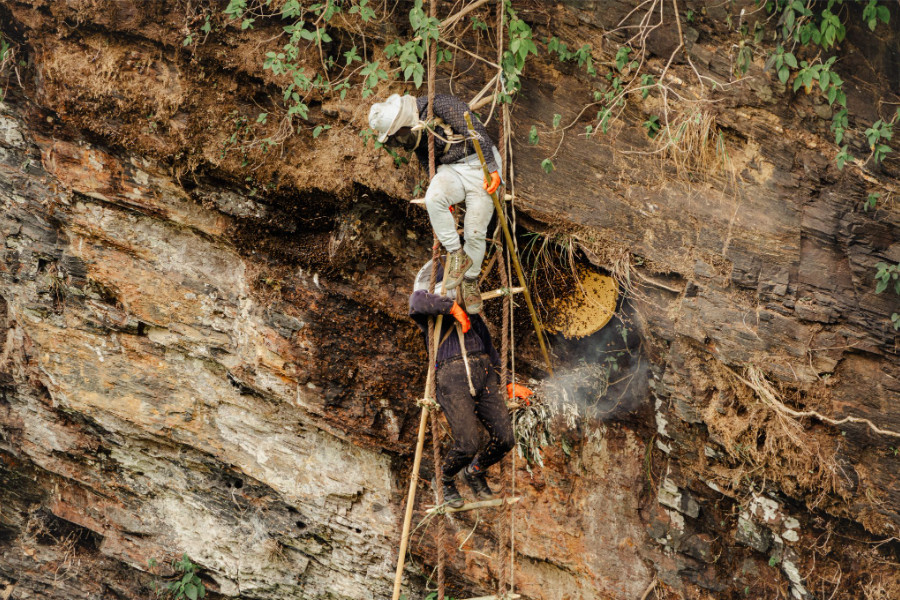
Apis laboriosa which is also known as Himalayan giant honeybee is the largest honeybee on planet earth. These honeybees can grow up to 3 cm long. They are found in the mountainous region of Nepal. They mostly nest at altitudes between 2500m and 3500m. They build very huge nests on the southwestern faces of vertical cliffs. These bees can forage at altitudes of up to 4500m (14764 ft).

The term Himalayan Honeybee is used because they are found in high Himalayan regions of Nepal and spend their whole life there. Apis Laboriosa is usually considered quite defensive and aggressive especially when its colony gets disturbed. Colonies can respond strongly if any disturbance occurs, particularly during honey hunting. Usually, they do not get aggressive without provocation. They do not attack people or animals passing nearby. But compared with many common bee species, Apis laboriosa dorsata is considered as a potentially dangerous defensive bee, when approaching an active colony.
Himalayan giant bees live in high altitude mountainous regions. They nest in steep, vertical cliff faces and they build massive nests under rock overhangs. The Himalayan giant bee can survive extreme high altitude up to 4500m (14764 ft). During different seasons they migrate across different altitudes following the seasonal bloom and return to the same identical nests. They are bigger than regular honeybees which makes them adapted to intense mountain weather.
People's interest in mad honey was triggered by a video and not by social media. The Last Honey Hunter is a documentary which was released in 2017 and talks about the honey hunting traditions of the Gurung community from Nepal. The video shows how honey hunting has been practiced by the locals for generations in the steep mountains in Nepal, and it is filmed by the community's aging leader. The North Face and National Geographic were the producers of the documentary, and the film made many people know about the honey hunting traditions. And for many people, it was the moment where mad honey went from a regional product to something they wanted to know more about.
As soon as the door was opened, the content creators stepped inside. Many YouTube channels and different content creators have successfully promoted mad honey. Travel vloggers are making films and videos about honey hunting in Nepal, there are taste tests, and some blogs actively explain “what is mad honey.” All these popularized mad honeys in front of those people who didn’t even know about it.
At the same time, it must be said that not all of these creators tell the same story. Plenty of content creators say weird things about mad honey on purpose for views. They show their shock, talk about strange things that mad honey does, or even make thumbnails that illustrate mad honey in such a way as if it was a stunt. A weird claim can make people click the video easier than an accurate one.
However, it should be noted that not everything that is being said about mad honey and its psychoactive properties seems to be accurate. Much of the material available online puts considerable emphasis on mad honey’s hallucinogenic properties, sometimes borderline coming up with works that look like ads for recreational drugs, stressing only on the positive effects like getting high or dizzy when taking mad honey. While it makes good thumbnails for websites, the headlines do not convey the full picture of the situation. For centuries mad honey has been used in tiny doses as a remedy for digestive problems, helping to relieve joint and muscle pains, and is a part of wellness tradition in the mountain areas it originates from. The "effects" are a small, dose dependent part of a much longer story about a honey that's been trusted as a natural remedy long before it became internet content.
Anyone who has actually experienced mad honey in a logical, smaller amount will likely agree on one thing – it’s more of a subtle experience than a dramatic one. The taste, which is often described as distinct, is somewhat different from standard honey, with people calling it slightly spicy or earthly and feels a tingling sensation in the throat. When it comes to the sensation, if any, it tends to be more along the lines of mild warmth or dizziness rather than anything even close to what is shown in popular videos.
Additionally, some people report different sensations from mad honey. Some of them feel no effects apart from the taste, others feel a mild sensation of warmth and light-headedness, while a few say they experienced stronger effects of euphoria and hallucinations. However, this is not due to mere coincidence and can be explained by the important factors like the dose an individual person took, their body weight and sensitivity, the composition of mad honey and its grayanotoxin count.
Peel away all the hype, and find a story that is worth knowing about. The harvesting of mad honey which comes at very high risk, from bees that live where almost nothing else can survive, and a centuries-old tradition still being practiced today. Aside from the implications of mad honey, people find it fascinating because of the stories and meanings associated with it, from culture and taste to the ability to connect with a rare tradition carried out by only a few people nowadays.
Companies like Mad Honey Store ( https://mad-honey.store/ ) source authentic mad honey directly from the village and deliver it world wide straight to the customers' doors. Selling village products, the company also promotes tourism by encouraging customers to visit the village, experience honey hunting, explore the natural surroundings, etc.
Mad honey's appeal is not really about a certain effect or a viral video. It has all to do with what happens prior to the consummation of the jar. A bee surviving in conditions where few can, harvesting done the same way throughout the centuries, a documentary making mad honey known to the world and online content promoting the story of mad honey ever since. This is more than enough to understand why this mad honey attracts people's attention. At the same time, no person experiences it the same way and this is why mad honey is an appealing substance.














© 2026 All right reserved to saurahaonline.com | Site By : Sobij
© 2026 All right reserved to saurahaonline.com | Site By : Sobij